8M

Lorem ipsum dolor sit amet, consectetur adipiscing elit, sed do eiusmod tempor incididunt ut labore et dolore magna aliqua. Ut enim ad minim veniam, quis nostrud exercitation ullamco laboris nisi ut aliquip ex ea commodo consequat. Duis aute irure dolor in reprehenderit in voluptate velit esse cillum dolore eu fugiat nulla pariatur.
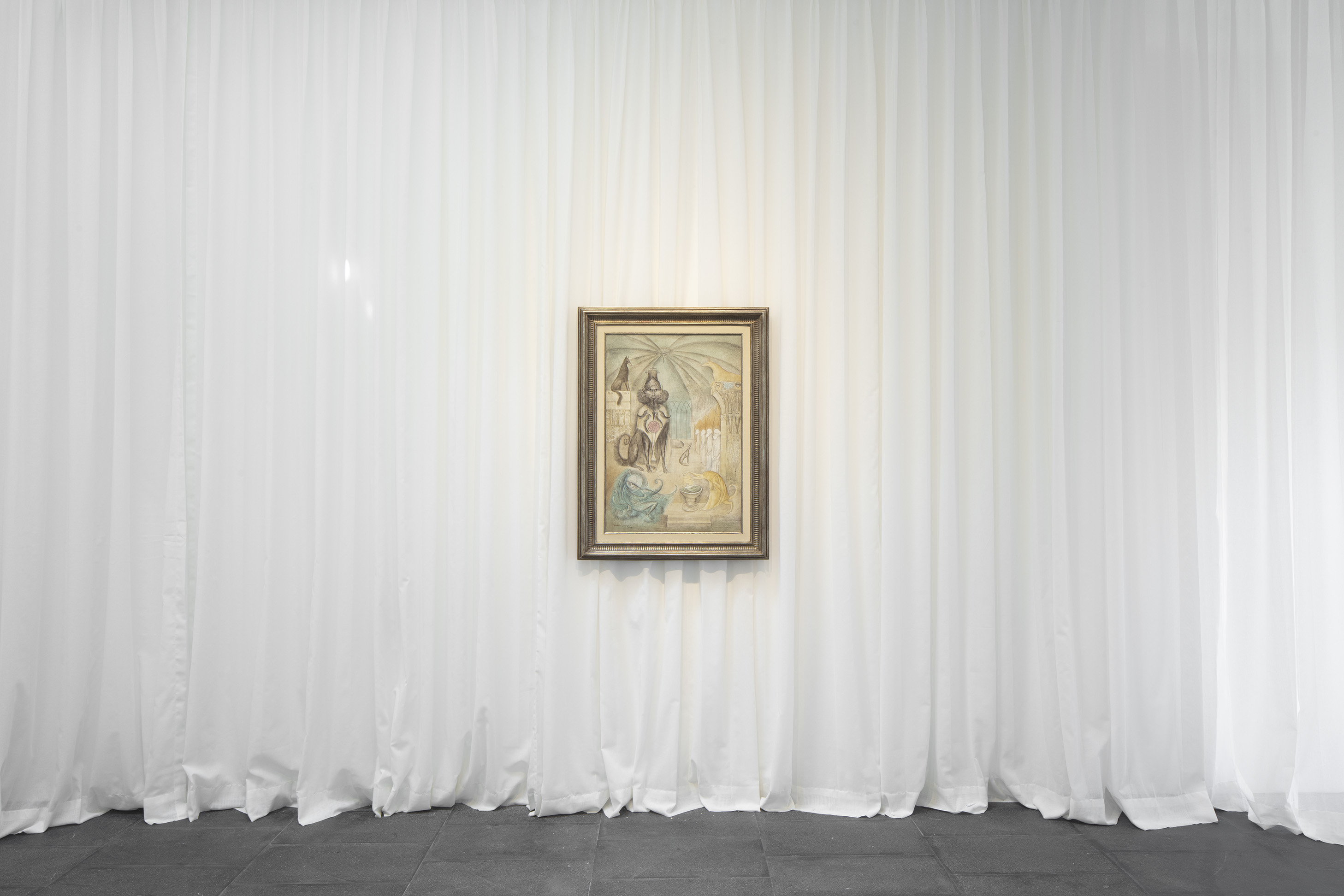
In 1964, when Ethiops was painted, Leonora Carrington was experiencing several momentous events. She had just completed her only large-scale mural, El mundo mágico de los mayas (1963), commissioned by the newly constructed Museo Nacional de Antropología, opening that year. It had been a long and arduous task, requiring numerous trips to Chiapas and the surrounding regions for research and preliminary studies. In October of 1963, however, tragedy struck with the unexpected and sudden death of Remedios Varo, her closest friend and artistic collaborator whose home and studio was nearby in Colonia Roma. In light of this, the majestic and mysterious Ethiops may be an esoteric rumination on mourning, death and alchemical processes of transformation and renewal.
Alchemy was a topic that had long intrigued Carrington and she studied its symbolism and applications to art making assiduously– even mixing her own paints with egg like artists of old. She had shared this interest with the surrealist Max Ernst,with whom she had been romantically involved in France in the later half of the 1930s. Her interest in alchemy was renewed upon her move to Mexico in 1942, enthusiastically shared with her new Spanish friend, Varo. Ethiops is one of three major works dedicated to the topic of alchemy that the artist was inspired to paint in 1964, the other two being The Burning of Giordano Bruno and The Chrysopeia of Mary the Jewess. Carrington’s paintings during the 1950s and 1960s at times took a turn towards the deeply hermetic, revealing the artists’ wide readings and her unique interpretation of esoteric traditions. It is in these works that the artist moves into a new signature style some distance from canonical surrealism, but one that will help shape future generations seeking more inclusive spiritual visions.
Subtly placed throughout the composition of Ethiops are allusions to alchemical processes, although Carrington also felt free to add elements from other occult philosophies and practices. For example, included on a wall to the left are Viking Runes, while atop a pier on the right is what appears to be a carving of a Green Man – those folkloric faces surrounded by leaves symbolizing nature and fertility found on medieval European churches. In fact, the cavernous interior portrayed is reminiscent of a medieval cathedral with Gothic pointed arches, and a multi-ribbed ceiling vault. A row of bearded men in long robes to the right adds to the ecclesiastic flavor of the setting, and their closed eyes and ghostly appearance suggest a somber chamber of reflection.
A host of canine creatures populate the space, seated like guardians atop columns, carved in a procession beneath the Runes, or performing ritualistic acts. These are Carrington’s signature human/animal hybrids, the most spectacular being the centrally black entity that is perhaps what the title is referring to. Ethiops is an archaic term from Greek/Latin meaning “burnt face,” denoting the people from the Sub-Saharan African country of Ethiopia. This figure has a beard and wears a conical crown with crosses, reminiscent of those worn by Ethiopian Christian priests (1). With its pointy ears and long hair and beard it also resembles a Sumerian Lamassu, those guardian hybrid sculptures with human heads, a bull body and birds bird wings. Carrington had long been interested in Mesopotamia and its archaeological remains and their architecture and sculptural and elements from their culture are scattered throughout her oeuvre.
Most significantly, the term “Ethiops” also refers to minerals in historical chemistry accounts, like black sulfide of mercury, thus linking it to alchemical operations. Furthermore, given its association with darkness, it can refer to one of the major alchemical distillation processes, known as the nigredo (blackening). The nigredo is the first stage in the alchemical magnum opus (great work), representing decomposition and putrefaction. This stage is followed by the albedo (whitening) stage of purification, and then the rubedo (reddening) of integration and completion (known as the creation of the Philosopher’s Stone). In Jungian psychology, which Carrington was very interested in, the nigredo specifically refers to confrontation with death and one’s shadow self - consisting of facing uncomfortable truths one needs to overcome in order for personal growth to occur. Strengthening this alchemical interpretation is the appearance of the large pink flower centrally placed on the cape worn by the creature. This is the “alchemical rose,” a motif that Carrington has placed in numerous other paintings (i.e. The Chair, Daghda Tuatha de Danaan, 1955 and AB EO QUOD, 1956) – a symbol representing spiritual transformation, wisdom, divine love and the union of opposites. One can see this rose repeated in blue above atop the column below the golden sentinel dog. In the foreground another golden canine, now robed with a sun emblem on his chest, appears to stir a white child in a baptismal font. Merrily mixing symbols to create a heretical soup, Carrington turns the Christian font into an alchemical alembic, those vessels used in chemical operations. Perhaps this white child represents the process of albedo – or it is a reference to the filius philosophorum (alchemical child) – symbol of the successful union of opposites (sun/moon, king/queen), the ultimate goal (another aspect of the Philosopher’s Stone).
The winged entity in the lower left corner appears to be observing the child with some interest. Reclining in a cloud of blue mist, it brings to mind the hummingbird figure from her mural El mundo mágico de los mayas, another hybrid entity, this time associated with Maya legends learned from her travels through Chiapas. As mentioned previously, 1964 will also see the creation of Carrington’s monumental The Chrysopeia of Mary the Jewess – a celebration of real women involved in alchemy, as well as The Burning of Giordano Bruno, a respectful nod to the 16th century Italian alchemist burnt at the stake for heresy by the Catholic Church. A pioneer and outlier herself, Leonora Carrington well understood the loneliness and bravery required of individuals who dare to question the status quo, but who can then move the arts, and humanity, forward.
(1) Carrington might have been interested in this region for Kabbalistic reasons since it believed that Ethiopian monks guard the famed Jewish Holy of Holies, the Ark of the Covenant, supposedly held in St. Mary Church of Zion in Aksum. Ethiopians believe that the Ark was transported from the Temple of Solomon by Menelik I, the son of King Solomon and the Queen of Sheba. Carrington would portray the Queen of Sheba in her 1947 painting The Temptation of St. Anthony.

Commodo diam libero vitae erat. Aenean faucibus nibh et justo cursus id rutrum lorem imperdiet. Nunc ut sem vitae risus tristique posuere.

%20-%20original.jpg)
